
Certificate Program · Medical Coding
Medical Coding Certification Course
Learn ICD-10-CM, CPT and HCPCS coding in 3 months, with anatomy, medical terms and step-by-step prep for the AAPC CPC exam. Study live online or in our classroom at HSR Layout, Bangalore.
- Duration
- 3 months
- Mode
- Online + Classroom
- Next batch
- 10 Oct 2026
- Certificate
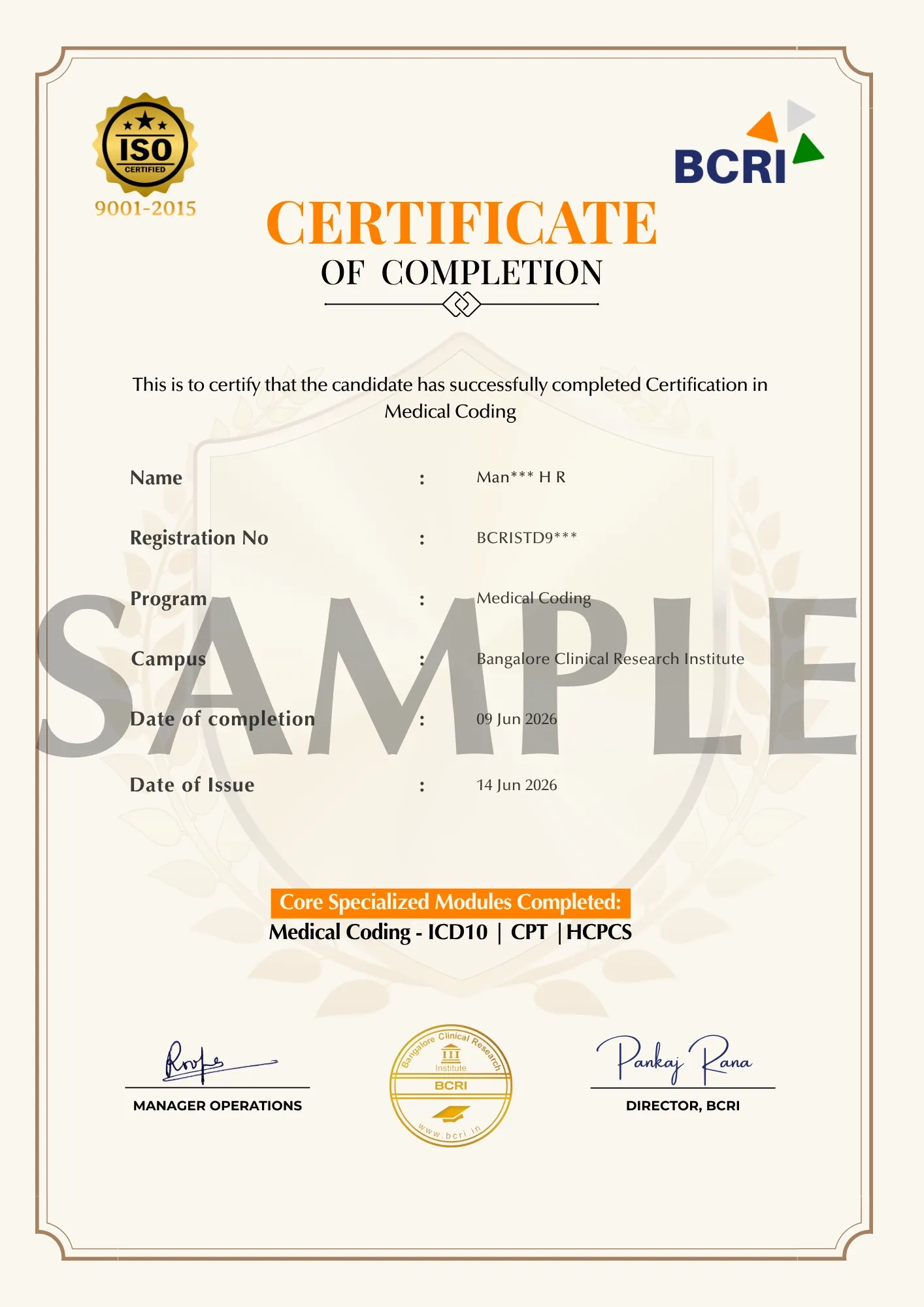
- BCRI certificate
Course fee₹25,000₹34,999



- LSSSDC · NSDC · Skill India training partner
At a glance
What is medical coding — and why learn it at BCRI?
BCRI’s Medical Coding Certification Course is a 3-month program. You learn to turn patient records into the ICD-10-CM, CPT and HCPCS codes used for US healthcare billing. It suits life science, pharmacy, nursing and allied health graduates. By the end, you are ready for the AAPC CPC exam and your first job as a medical coder.
Medical coding means turning what a doctor writes in a patient’s record into short standard codes. Diagnoses use ICD-10-CM codes. Procedures use CPT codes. Supplies and services use HCPCS Level II codes. Hospitals and insurers use these codes to process claims and pay bills.
At Bangalore Clinical Research Institute, our medical coding training follows the latest ICD-10-CM, CPT and HCPCS guidelines. These are the same rules used by hospitals, billing companies and healthcare firms.
We focus on clear concepts, accuracy and the rules you must follow. You learn how to pick the right code and why a wrong code causes problems for patients, payments and audits. Real case studies, mock coding tests and regular assessments help you move from theory to daily coding work.
Last updated
Why BCRI
Why choose BCRI for your medical coding course?
Online or classroom
Join live online from anywhere, or attend classes at the BCRI campus in HSR Layout, Bangalore.
CPC exam preparation
Modules mapped to the AAPC CPC exam, with mock tests and revision classes.
Recorded classes
Revisit lectures through recorded sessions on the BCRI class app.
Case-based practice
Code real patient cases across body systems and specialties.
Experienced trainers
Learn from people who have worked in medical coding, billing and records.
Placement assistance
Resume building, mock interviews and referrals to healthcare and medical billing companies.

Skills you will gain
- Proficiency in ICD-10-CM, CPT and HCPCS Level II coding systems
- Medical terminology, human anatomy and body systems
- How the healthcare revenue cycle (RCM) and insurance claims work
- Interpreting and coding patient records and procedures
- Coding guidelines, payer rules and HIPAA compliance
- Code auditing, modifiers and crosswalking between code sets
- Readiness for certification exams such as AAPC CPC or AHIMA CCA
Curriculum
Medical coding course syllabus
Five modules taking you from healthcare basics to exam-ready coding practice.
- Modules
- 5
- Topics
- 22
- Duration
- 3 months
Want the detailed syllabus?
An advisor will share the full module plan on WhatsApp or email.
Get the syllabus1
Introduction to Healthcare & Revenue Cycle Management
3 topics- The healthcare process
- Revenue Cycle Management (RCM)
- Payer systems and insurance claims
2
Human Anatomy, Physiology & Medical Terminology
5 topics- Human body systems, medical terms and abbreviations
- Blood & lymphatic, integumentary, musculoskeletal, respiratory and cardiovascular systems
- Digestive, genitourinary, endocrine and nervous systems
- Mental disorders, eye & adnexa, ear & mastoid
- Pregnancy and congenital malformations
3
ICD-10-CM Diagnosis Coding
5 topicsGuidelines, structure and format, then coding by body system and code range.
- A00–B99 Infectious diseases · C00–D49 Neoplasms
- E00–E89 Endocrine, nutritional and metabolic
- I00–I99 Circulatory · J00–J99 Respiratory
- M00–M99 Musculoskeletal · O00–O9A Pregnancy and puerperium
- Z00–Z99 Factors influencing health status
4
CPT & HCPCS Procedure Coding
5 topics- CPT Category I: Anesthesia, Surgery, Radiology, Laboratory, Medicine, Evaluation & Management (E/M)
- CPT Category II and III codes
- Modifiers and their correct use
- HCPCS Level II codes for equipment, supplies and services
- Crosswalking between ICD-10-CM, CPT and HCPCS
5
Soft Skills, Interview Preparation & Final Assessment
4 topics- Communication skills
- Coding accuracy practices
- Resume building and interview preparation
- Final evaluation and mock coding exam
Fees & batches
Medical Coding Certification Course fees and upcoming batches
Course fee
₹25,000₹34,999Save ₹9,999
3 months · Live online or classroom (HSR Layout, Bangalore)
What’s included
- Live interactive classes — online or classroom
- ICD-10-CM, CPT and HCPCS coding modules
- Study material, plus class recordings for online batches
- Mock coding exams for CPC preparation
- Resume, interview and placement assistance
- BCRI Medical Coding Certificate
Fees exclude the AAPC/AHIMA exam fee, which is paid to the certifying body. Instalment options are available — ask an advisor.
Compare all course fees →Upcoming batches
- Reserve a seat
Live online batch
Starts 10 Oct 2026
Ends 30 Dec 2026 · Live online · 9:30–11:00 AM IST
- Reserve a seat
Classroom batch · HSR Layout
Starts 16 Oct 2026
Ends 29 Jan 2027 · BCRI, HSR Layout, Bengaluru
- Monday–Friday classes
- Recordings for online batches
- Online or HSR Layout, Bengaluru
- Instalment options available
Certification
Medical coding certification and CPC exam preparation
On completion you receive the BCRI Certificate of Completion in Medical Coding, listing the core modules you completed — ICD-10, CPT and HCPCS. The course is designed to prepare you for international certification exams — most learners take the AAPC Certified Professional Coder (CPC) exam after the course. Certification is not required by every employer, but it strengthens your profile.
BCRI supports your exam preparation with expert-led sessions aligned to the exam blueprint, study material, mock exams and practice questions, and focused review sessions before your attempt.
- CPC — Certified Professional Coder AAPC
- The most widely recognised credential for coders in physician offices, outpatient settings and healthcare BPOs.
- CCA — Certified Coding Associate AHIMA
- An entry-level credential for beginners in medical coding.
- CCS — Certified Coding Specialist AHIMA
- An advanced credential suited to hospital and inpatient coding.
- COC — Certified Outpatient Coder AAPC
- Focused on facility-based outpatient coding.
What your certificate shows
- Certificate of CompletionIssued by Bangalore Clinical Research Institute
- Core modules completedICD-10 · CPT · HCPCS
- Registration numberUnique to you and verifiable online
Recognition marksISO 9001:2015
Careers & salary
Career opportunities after the medical coding course
Certified medical coders work across hospitals, insurance companies and healthcare outsourcing firms, mostly on US healthcare projects. Most start as trainee coders and grow into senior, quality and leadership roles.
Job roles you can apply for
- Medical Coder (ICD-10-CM, CPT, HCPCS)
- Junior Medical Coding Executive
- Medical Billing & Reimbursement Analyst
- Coding Quality Analyst / Auditor
- Clinical Documentation Specialist
- Denial Management Executive
Where you can work
- Multispecialty hospitals and clinics
- Health insurance companies
- Medical billing firms and healthcare BPOs
- Third-party RCM providers
- Telehealth and digital health companies
Hiring locations
- Bengaluru
- Hyderabad
- Chennai
- Mumbai
- Pune
- Kochi
- Remote roles on US healthcare projects
Typical career progression
- 1
Entry
Trainee Coder · Medical Coder
- 2
2–4 years
Senior Coder · Coding Quality Analyst
- 3
5+ years
Coding Auditor · Team Lead · Process Lead
- 4
Leadership
Assistant Manager · Coding Manager · Trainer / Consultant
Salary range — market data
| Role | Experience | Typical salary | Source |
|---|---|---|---|
| Medical Coder · Bengaluru | 0–4 years | ₹3.6 – 4 lakh per year | AmbitionBox, 1.8k salaries, updated 5 Oct 2026 |
| Senior Medical Coder · Bengaluru | 2–7 years | ₹5.4 – 5.9 lakh per year | AmbitionBox, 1.1k salaries, updated 6 Oct 2026 |
Figures are third-party market data for these roles, not BCRI placement outcomes. Actual pay depends on the employer, skills, certification and interview performance.
Student proof
Medical coding course reviews, placements and student stories
4.6
BCRI is rated 4.6/5 from 987 Google reviews (as of Oct 2026)
Recent BCRI placements & internships

Watch

Life science students: become a certified medical coder with BCRI
Is this course right for you?
Talk to a BCRI advisor about eligibility, batches, fees and career paths. It’s free and there’s no obligation.
FAQs
Medical Coding Certification Course — frequently asked questions
What is medical coding?
Medical coding turns the diagnoses and treatments in a patient’s record into short standard codes. Diagnoses use ICD-10-CM codes, procedures use CPT codes, and supplies use HCPCS Level II codes. Hospitals and insurers use these codes for claims, payments and health records.
Who can join the medical coding course?
Graduates and postgraduates in medical, paramedical and life science fields — for example BDS, BAMS, BHMS, BPT, MPT, BOT, MOT, B.Pharm, M.Pharm, nursing, and B.Sc or M.Sc in biotechnology, microbiology, biochemistry, zoology, botany or bioinformatics.
How long is the medical coding course and what does it cost?
The course runs for 3 months, with Monday-to-Friday batches online and at HSR Layout, Bangalore. The current fee is ₹25,000 (list price ₹34,999), excluding the AAPC or AHIMA exam fee. Instalment options are available.
What does a medical coder do?
A medical coder reviews patient records and clinical documentation, assigns ICD-10-CM, CPT and HCPCS codes to diagnoses and procedures, checks compliance with coding guidelines and payer rules, and supports accurate billing and claims. Coders work closely with billing teams, providers and insurers.
Which medical coding certification should I take?
Most freshers take the AAPC CPC (Certified Professional Coder) exam, the most widely recognised credential for outpatient and BPO coding. AHIMA’s CCA is an entry-level alternative, CCS suits hospital inpatient coding, and AAPC’s COC focuses on facility outpatient coding. BCRI’s course prepares you mainly for CPC.
What is the CPC exam format?
AAPC’s CPC exam has 100 multiple-choice questions in 4 hours, and you need 70% to pass. You may bring three code books: CPT, ICD-10-CM and HCPCS Level II. If you pass without two years of coding work, you become a CPC-A (apprentice) until you meet AAPC’s experience rules.
How do I prepare for the CPC exam?
Study ICD-10-CM, CPT and HCPCS guidelines, revise medical terminology and anatomy, and practise extensively with real-world coding cases and timed mock exams. BCRI’s course includes expert-led sessions, study material, mock exams and focused review sessions before your attempt.
What jobs can I get after a medical coding course?
Most freshers start as trainee or junior medical coders. With a few years of experience, you can become a senior coder, quality analyst or auditor. Later you can lead a team or a process. Some coders move into billing, denial management or clinical documentation.
What is the salary of a medical coder in Bangalore?
According to AmbitionBox (updated 5 Oct 2026, 1.8k salaries), medical coders in Bengaluru with 0–4 years of experience typically earn ₹3.6–4 lakh per year, and senior medical coders with 2–7 years earn about ₹5.4–5.9 lakh per year. Actual pay depends on the employer, skills and certification.
Is the medical coding course available online?
Yes. Live, instructor-led online batches use the same curriculum and trainers as the classroom batches, with class recordings and placement assistance included.
Does BCRI provide placement support after the medical coding course?
Yes. Our placement team helps you with your resume, interview practice and job referrals to healthcare and billing companies. The employer makes the final hiring decision based on your interview, so a job is not guaranteed.