
Post Graduate Diploma · Clinical Research
✓ Dual certification: BCRI + LSSSDCPG Diploma in Clinical Research with Clinical SAS Programming
Our PG Diploma in Clinical Research is a 7.5-month programme for graduates who want a long career in clinical research. You learn CR, CDM, pharmacovigilance, regulatory basics and Clinical SAS, with hands-on training and mentoring.
- Duration
- 7.5 months
- Mode
- Online + Classroom
- Next batch
- Every month
- Certificate
- BCRI + LSSSDC
Course fee₹75,500₹85,000



- LSSSDC · NSDC · Skill India training partner
At a glance
What is the PG Diploma in Clinical Research — and why study it at BCRI?
BCRI’s PG Diploma in Clinical Research (PGDCR) is a 7.5-month programme in four parts: clinical trials, clinical data, drug safety and Clinical SAS. You study live online or at HSR Layout, Bangalore, with trainers who have 10 to 20+ years of industry experience, and then do an internship. It suits pharmacy, life science and medical graduates who want a full start in clinical research.
At Bangalore Clinical Research Institute, our PGDCR bridges the gap between what you learn in college and how clinical research works in real jobs.
You train in clinical research, data management and drug safety, then learn Clinical SAS. Each module builds on the last. You finish ready for jobs in CROs, pharma companies and research sites.
You can study live online from anywhere in India, or in our classroom at HSR Layout, Bengaluru. Every diploma student also does a 3 to 6 month internship with an SMO, CRO or hospital.
Last updated
Why BCRI
Why choose BCRI for your PG Diploma?
Four domains in one diploma
Clinical research, CDM, pharmacovigilance and Clinical SAS, taught in a planned sequence.
Trainers with 10–20+ years’ experience
Live classes from senior professionals with 10 to 20+ years in CROs, pharma companies and Clinical SAS.
LMS access and online recordings
Notes and study material on the BCRI app; online batches can revisit sessions for 3 months.
Hands-on SAS training
Base and Advanced SAS, CDISC SDTM, ADaM and TLFs on real trial data standards.
Internship included
A 3 to 6 month internship with an SMO, CRO or hospital, mostly in Bangalore.
Placement assistance
Resume help, mock interviews and interview referrals, with a dedicated placement officer.

Learning objectives
- Run the clinical research process: planning a trial, essential documents (protocol, CRF, IB, ICF), EC and regulatory submissions
- Manage a trial: monitoring, SAE reporting and trial management
- Design databases, enter and validate data, and follow 21 CFR Part 11
- Get hands-on experience with OpenClinica and EDC tools
- Identify, report and analyse adverse events under global PV rules
- Apply ICH E9 and SOPs to clinical data work
- Program in Base and Advanced SAS and produce SDTM, ADaM and TLF outputs
Curriculum
PG Diploma in Clinical Research syllabus
Four connected domains, taught in sequence over 7.5 months and aligned with ICH-GCP, FDA, CDISC and MedDRA standards.
- Modules
- 4
- Topics
- 23
- Duration
- 7.5 months
Want the detailed syllabus?
An advisor will share the full module plan on WhatsApp or email.
Get the syllabus1
Clinical Research
6 topicsTrial design, regulatory pathways, ethics and stakeholder roles in global clinical trials.
- Overview of clinical trials, phases (0–5) and study designs
- Drug development process and IND/NDA submissions
- Study set-up: protocols, CRF design, SOPs, ethics committees
- Trial design: efficacy, safety, microdosing, SAD/MAD
- Trial documentation: Investigator’s Brochure, logs, visit forms
- Quality assurance and regulatory requirements
2
Clinical Data Management
5 topicsThe trial data lifecycle: CRF design, query handling, data cleaning, coding and audit readiness.
- Data collection, CRF tracking and eCRF set-up
- Database design, data validation plans and DVS
- Discrepancy management, query resolution and audit trails
- Tools: RDC, IxRS, CTMS and EDC validation
- SAE reconciliation, medical coding, UAT and lab data integration
3
Pharmacovigilance
6 topicsIdentifying, reporting and analysing adverse events while meeting regulatory rules.
- AE/SAE identification, reporting and timelines
- PV databases, case processing and duplicate search
- MedDRA and WHO-DD coding; signal detection
- DSUR, PSUR, PBRER and aggregate reporting
- Special cases: off-label use, pregnancy, lack of efficacy, medication errors
- Regulators: FDA, EMA, CIOMS, WHO-UMC, CDSCO
4
Clinical SAS Programming
6 topicsBase and Advanced SAS, CDISC SDTM, ADaM and TLFs to turn trial data into regulatory-ready outputs.
- Base SAS: DATA and PROC steps, import/export, functions
- Advanced SAS: PROC SQL, macros, debugging, joins
- CDISC SDTM and ADaM: mapping, Define.xml, TLF generation
- Statistical analysis: PROC TTEST, ANOVA, GLM, LIFETEST
- Report automation with ODS and SAS macros
- Regulatory submission standards (FDA/EMA)
Fees & batches
PG Diploma in Clinical Research fees and upcoming batches
Course fee
₹75,500₹85,000Save ₹9,500
7.5 months · Live online or classroom (HSR Layout, Bangalore)
What’s included
- Live instructor-led online training
- Offline classroom option at HSR Layout, Bengaluru
- Exposure to EDC and safety databases
- Live hands-on SAS training; biostatistics and data analysis
- 3–6 month internship with an SMO, CRO or hospital
- LMS access, 3-month recordings for online batches, placement assistance
Paying the full fee online? Choose “Pay in full online” when you apply and get 5% off. Instalment options are available — ask an advisor. New batches start every month.
Compare all course fees →Upcoming batches
New batches start every month — online and at HSR Layout.
Classes run Monday to Friday. Ask an advisor for the next start date.
- Monday–Friday classes
- Recordings for online batches
- Online or HSR Layout, Bengaluru
- Instalment options available
Certification
PG Diploma certification
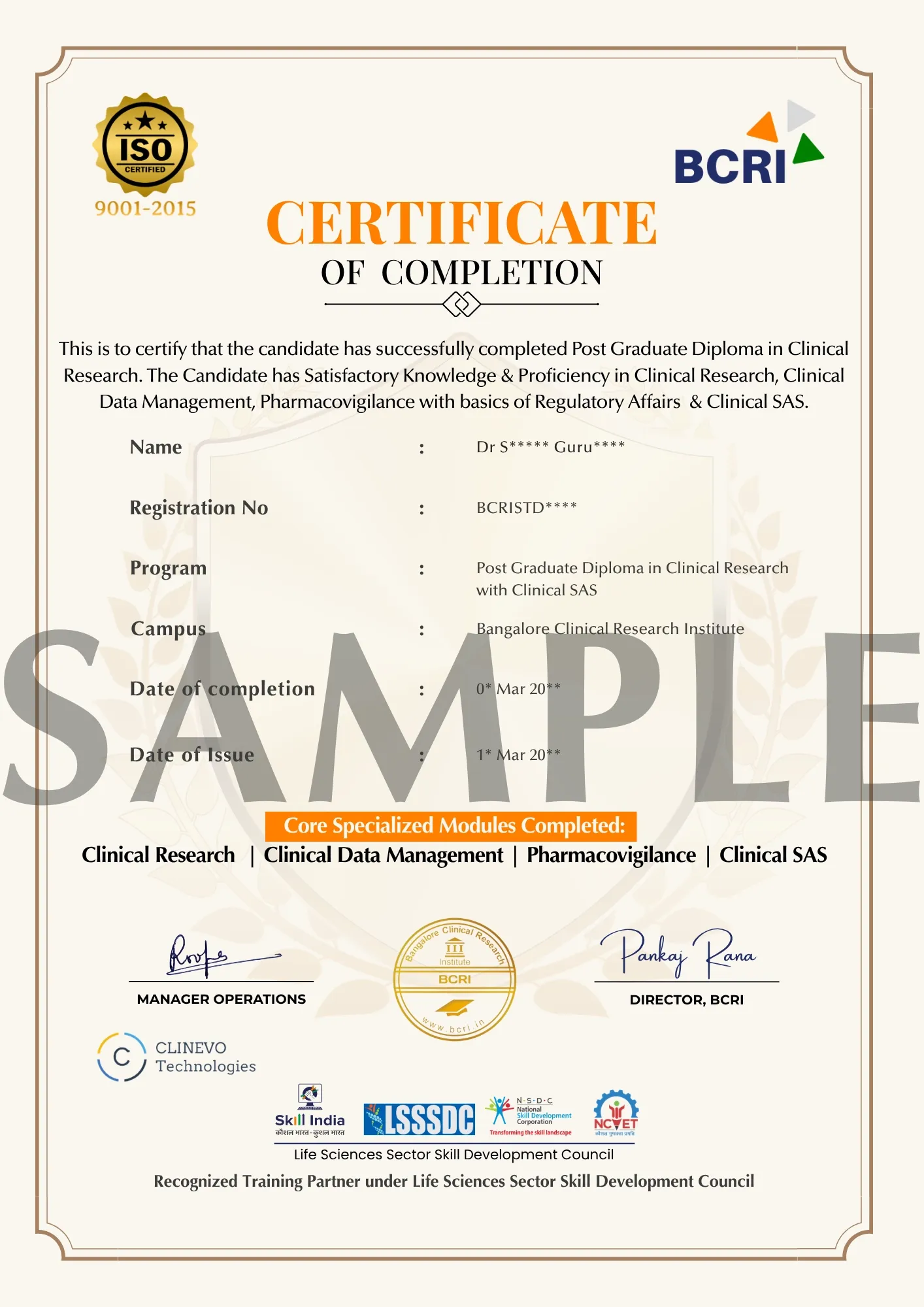
On completion you receive the BCRI Post Graduate Diploma in Clinical Research with Clinical SAS. It lists your four core modules and carries the Skill India, LSSSDC, NSDC and NCVET marks, as BCRI is a recognised training partner under the Life Sciences Sector Skill Development Council.
You are assessed through assignments, mock tests, a final assessment and a project. The diploma is also part of BCRI’s Dual Certification: pass LSSSDC’s offline exam to earn a second, NSQF-aligned certificate.
What your certificate shows
- Certificate of CompletionIssued by Bangalore Clinical Research Institute
- Core modules completedClinical Research · Clinical Data Management · Pharmacovigilance · Clinical SAS
- Registration numberUnique to you and verifiable online
Recognition marksISO 9001:2015 · Skill India · LSSSDC · NSDC · NCVET · Clinevo
Dual Certification Advantage
Dual certification: BCRI + LSSSDC
With BCRI’s Dual Certification, you earn two certificates from one programme. The first is your BCRI course certificate. The second is a national skill certificate from the Life Sciences Sector Skill Development Council (LSSSDC), which you get after you pass its offline exam. The LSSSDC certificate follows India’s National Skills Qualifications Framework (NSQF).

Certificate 1 · BCRI
BCRI Course Certificate
- When:
- Awarded when you complete the course and BCRI’s internal assessments.
- What it shows:
- Shows the programme and core modules you completed, issued by an ISO 9001:2015 certified institute.
Certificate 2 · LSSSDC
LSSSDC Skill Certificate (NSQF-aligned)
- When:
- Awarded after you clear LSSSDC’s offline assessment, conducted independently by LSSSDC or its authorised assessment agency.
- What it shows:
- Certifies your skills against a national Qualification Pack for the life sciences sector, under the Skill India / NSDC ecosystem.
Step 1
Train
Complete your BCRI programme — live online or at HSR Layout.
Step 2
BCRI assessment
Clear BCRI’s internal assessments and receive your BCRI certificate.
Step 3
LSSSDC assessment
Take LSSSDC’s offline assessment, conducted independently by LSSSDC or its authorised agency.
Step 4
LSSSDC certificate
Pass the exam and receive your NSQF-aligned LSSSDC skill certificate.
You get the LSSSDC certificate only after you pass LSSSDC’s offline assessment.
Careers & salary
Career opportunities after the PG Diploma
With a PG Diploma you can apply for jobs in clinical data, drug safety, trial operations and SAS programming. That gives you more choices than a one-skill certificate.
Job roles you can apply for
- Clinical SAS Programmer
- Clinical Data Analyst
- Clinical Research Associate (CRA)
- Clinical Trial Coordinator
- Drug Safety Associate
- Medical Data Reviewer
- Pharmacovigilance Analyst
- Clinical Operations Executive
Where you can work
- Contract research organisations (CROs)
- Pharmaceutical and biotech companies
- Healthcare BPOs and IT firms
- Site management organisations (SMOs)
- Hospitals and clinical trial sites
- CDM and SAS consulting firms
Hiring locations
- Bengaluru
- Hyderabad
- Mumbai
- Pune
- Chennai
- NCR
- Remote roles for US-based CROs
Typical career progression
- 1
Entry
CRC · Clinical Data Coordinator · DSA · Junior SAS Programmer
- 2
2–4 years
CRA · Senior Data Coordinator · SAS Programmer
- 3
4–7 years
Senior CRA · Clinical Data Manager · Statistical Programmer
- 4
Leadership
Clinical Project Manager · Data Management Lead · Programming Lead
Salary range — market data
| Role | Experience | Typical salary | Source |
|---|---|---|---|
| Clinical SAS Programmer · Bengaluru | 1–6 years | ₹6.4 – 7 lakh per year | AmbitionBox, 277 salaries, updated 13 Sep 2026 |
| Clinical Research Associate · Bengaluru | 1–6 years | ₹5.8 – 6.4 lakh per year | AmbitionBox, 524 salaries, updated 3 Oct 2026 |
| Clinical Data Coordinator · Bengaluru | 1–6 years | ₹4.9 – 5.5 lakh per year | AmbitionBox, 154 salaries, updated 2 Oct 2026 |
| Drug Safety Associate · Bengaluru | 0–4 years | ₹3.8 – 4.2 lakh per year | AmbitionBox, 747 salaries, updated 7 Oct 2026 |
Figures are third-party market data for these roles, not BCRI placement outcomes. Actual pay depends on the employer, skills, certification and interview performance.
Student proof
PG Diploma reviews, placements and student stories
4.6
BCRI is rated 4.6/5 from 987 Google reviews (as of Oct 2026)
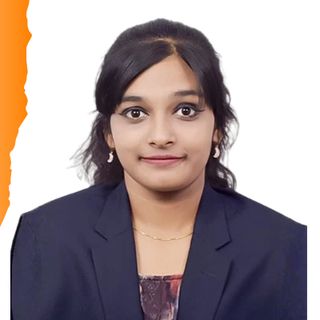
I did my PG Diploma in Clinical Research at BCRI. The programme helped me upskill in clinical research after my graduation. It includes complete knowledge of clinical research, clinical data management, pharmacovigilance and SAS.
Nikita Jaiswal — PGDCR Classes were very informative. Mayuri ma’am and Samarth sir are very knowledgeable and explained every part of clinical research, which made the classes interesting. Very good institute.
Meghna Mahesh — PGDCR & Pharmacovigilance My training at BCRI has been great. I completed my PG diploma in clinical research, clinical data management, pharmacovigilance and RA with excellent support and guidance from the faculty.
Naga Nikhila — PGDCR
Recent placements & internships from this programme



Watch

From BCRI SAS training to GSK — Himani’s placement journey

Is Clinical SAS worth it for a career?

Dr Nupur Pandit
Read story of Dr Nupur Pandit →
Minakshi Kommoju
Read story of Minakshi Kommoju →
Shivam Vishwakarma
Read story of Shivam Vishwakarma →
Shobith
Read story of Shobith →
Is this course right for you?
Talk to a BCRI advisor about eligibility, batches, fees and career paths. It’s free and there’s no obligation.
FAQs
PG Diploma in Clinical Research — frequently asked questions
What is the full form of PGDCR?
PGDCR stands for Post Graduate Diploma in Clinical Research. At BCRI it is offered in two tracks: with Clinical SAS (7.5 months) and with CRA/CRC (5.5 months).
What is the PGDCR course?
PGDCR is BCRI’s 7.5-month postgraduate diploma. It covers clinical trials, clinical data management, drug safety and Clinical SAS. It includes a 3 to 6 month internship and prepares you for your first job in a CRO or pharma company.
What does the PG Diploma cost?
The PG Diploma with SAS costs ₹75,500 (list price ₹85,000). Paying the full fee online when you apply gives 5% off, and instalments are available. See the course price list for all fees.
Who is eligible for the PG Diploma?
Graduates in science (biochemistry, microbiology, genetics, biotechnology, botany, zoology), medicine (MBBS, BDS, BPT, BAMS, BHMS, BUMS) and pharmacy (B.Pharm, Pharm.D) can join. Working healthcare professionals are also eligible.
How long is the course, and can I study online?
The diploma takes 7.5 months. You can join live online classes from anywhere, or attend at our HSR Layout campus in Bangalore. New batches start every month. Everyone gets LMS access, and online batches also get recordings.
Is an internship included?
Yes. The PG Diploma includes a 3 to 6 month internship with an SMO, CRO or hospital, mostly in Bangalore and South India. The host awards the internship certificate and decides any stipend. For online students the internship is optional and needs you to move to the internship city.
What certificate will I get?
You receive the BCRI Post Graduate Diploma in Clinical Research with Clinical SAS. Through BCRI’s Dual Certification, you can also earn an NSQF-aligned LSSSDC certificate by passing LSSSDC’s offline exam.
How is the PG Diploma different from the Advanced Diploma?
The PG Diploma takes 7.5 months and adds Clinical SAS programming to clinical research, CDM and pharmacovigilance. The Advanced Diploma takes 4 months and covers CR, CDM and PV without SAS. Both include an internship.
What jobs can I get after the PG Diploma?
Common first jobs are Clinical Research Coordinator, Clinical Data Coordinator, Drug Safety Associate and Junior SAS Programmer. Later you can become a CRA, data manager, statistical programmer or project manager.
What salary can I expect after the PG Diploma?
It depends on the role. AmbitionBox (Sep–Oct 2026) reports Clinical SAS Programmers in Bengaluru earning about ₹6.4–7 lakh a year and Clinical Research Associates about ₹5.8–6.4 lakh, both with 1–6 years of experience. Freshers usually start lower.
Does BCRI provide placement support?
Yes. A dedicated placement officer helps you with your resume, mock interviews and interview referrals to CROs, hospitals and pharma analytics firms. The employer makes the final hiring decision, so a job is not guaranteed.