
BCRI | CDM vs Pharmacovigilance Guide 2026 | bcri.in
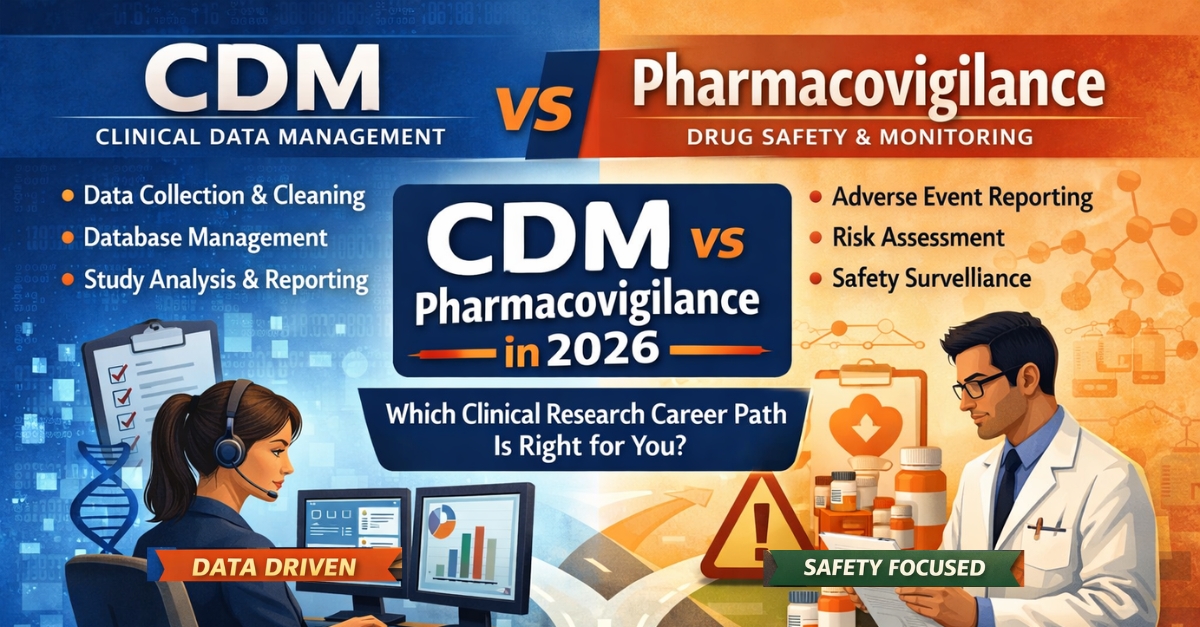
CDM vs Pharmacovigilance in 2026: Which Clinical Research Career Path Is Right for You?
11 min read | Last Updated: March 3, 2026
By Ms. Divya, M.Pharm (Pharmacology) Senior Faculty BCRI | 11+ years in CDM & Drug Safety |
| This in-depth comparison helps you choose between Clinical Data Management (CDM) and Pharmacovigilance (PV) — two of the most popular career paths in clinical research. You will understand the day-to-day work, key skills, software tools, salary ranges, and long-term career trajectory in each field. By the end, you will have a clear picture of which path fits your strengths, interests, and goals. |
You have a B.Pharm or M.Sc. degree. You know you want a career in clinical research. But then everyone tells you: “Go for CDM” or “PV is better.” And you have no idea who to listen to.
Here’s the truth: both CDM and PV are excellent career choices. They are both in high demand, both pay well, and both offer long-term career growth. The right choice depends on your personal skills, interests, and work style — not on which one is “trending.”
This guide breaks down the two roles completely so you can make an informed decision — not an impulsive one.
What Is Clinical Data Management (CDM)?
CDM is the process of collecting, cleaning, and managing data from clinical trials. CDM professionals ensure that the data used in drug regulatory submissions is accurate, complete, and trustworthy.
Think of CDM as the quality control backbone of a clinical trial. Before a statistician can analyse the data, and before the FDA or CDSCO reviews the results, a team of CDM professionals has cleaned and validated every data point.
What CDM professionals actually do:
- Design Case Report Forms (CRFs) — electronic or paper forms used by sites to record patient data
- Build and test Clinical Trial Databases (using tools like Oracle Clinical, Medidata Rave)
- Write Data Validation Specifications (DVS) to flag errors
- Run data cleaning — resolving discrepancies and queries
- Perform coding of adverse events and medications using MedDRA and WHO Drug Dictionary
- Prepare for database lock (final clean dataset for statistical analysis)
- Follow CDISC CDASH standards for data collection
- Produce SDTM and ADaM datasets for regulatory submission
- Key CDM regulatory standards:
- ICH E6(R2) — GCP
- CDISC CDASH and SDTM
- FDA 21 CFR Part 11 (electronic records)
- GCDMP (Good Clinical Data Management Practices)
What Is Pharmacovigilance (PV)?
Pharmacovigilance is the science of monitoring the safety of medicines once they are on the market — and during clinical development. PV professionals detect, assess, understand, and prevent adverse effects (side effects) of drugs.
Think of PV as the safety watchdog of the pharmaceutical industry. While CDM looks at trial data quality, PV looks at patient safety.
What PV professionals actually do:
- Process Individual Case Safety Reports (ICSRs) — reports of adverse events from patients, doctors, or companies
- Enter cases into safety databases (Oracle Argus Safety, AERS, Veeva Vault Safety)
- Perform Medical Coding using MedDRA terminology
- Identify signals — patterns in safety data that might indicate a new risk
- Prepare Periodic Safety Update Reports (PSURs/PBRERs) for regulators
- Submit reports to CDSCO, FDA, EMA within regulatory timelines
- Review literature for safety information
- Support Risk Management Plans (RMPs)
- Key PV regulatory standards:
- ICH E2A (Clinical Safety Data Management)
- ICH E2B (Electronic Transmission of ICSRs)
- WHO Uppsala Monitoring Centre guidelines
- CDSCO PV guidelines
- EMA GVP (Pharmacovigilance Good Practices)
CDM vs PV — Side-by-Side Comparison Table
| Comparison Factor | Clinical Data Management (CDM) | Pharmacovigilance (PV) |
| Primary Focus | Trial data quality and integrity | Drug safety monitoring |
| Phase of Drug Development | During clinical trials (Phases I–IV) | Primarily post-marketing; also during trials |
| Work Environment | Office-based, typically remote-friendly | Office-based, remote-friendly |
| Key Tools | Oracle Clinical, Medidata Rave, Veeva Vault, InForm | Oracle Argus Safety, AERS, EVWEB |
| Medical Knowledge Required | Moderate (coding, adverse events) | High (medical terminology, causality assessment) |
| Programming/Technical Skill | High (database building, SQL basics) | Low to moderate (data entry, coding) |
| Regulatory Knowledge | CDISC, ICH E6, FDA 21 CFR | ICH E2A/E2B, WHO, EMA GVP, CDSCO |
| Fresher Starting Salary | ₹3.5–5.0 LPA | ₹3.0–4.5 LPA |
| Senior Professional Salary | ₹12.0–20.0 LPA | ₹10.0–18.0 LPA |
| Travel Required | Rare | Very rare |
| Job Titles (Entry) | Data Coordinator, Junior CDM | PV Associate, Drug Safety Associate |
| Career Ceiling | Director of Data Management | Head of Pharmacovigilance / VP Drug Safety |
| International Opportunities | Excellent | Excellent |
| Work Pace | Project-driven (busy at database lock) | Volume-driven (consistent case processing) |
CDM Career Path — What Does Growth Look Like?
Typical CDM career progression:
- Data Coordinator / CDM Associate (0–1 year) — ₹3.5–5.0 LPA
- Junior CDM / CDM I (1–3 years) — ₹5.0–8.0 LPA
- Senior CDM (3–6 years) — ₹8.0–14.0 LPA
- Lead CDM / CDM Project Lead (6–10 years) — ₹14.0–20.0 LPA
- Director of Data Management / Head of CDM (10+ years) — ₹25.0–40.0 LPA
Key skills to develop for CDM growth:
- CDISC SDTM and ADaM proficiency
- Oracle Clinical and Medidata Rave expertise
- SQL and database management basics
- Project management (PMP or equivalent is valued at senior levels)
- Regulatory submission experience (eCTD knowledge)
Pharmacovigilance Career Path — What Does Growth Look Like?
Typical PV career progression:
- PV Associate / Drug Safety Associate (0–1 year) — ₹3.0–4.5 LPA
- PV Specialist (1–3 years) — ₹5.0–8.0 LPA
- Senior PV Specialist (3–6 years) — ₹8.0–12.0 LPA
- PV Team Lead / Signal Detection Specialist (6–10 years) — ₹12.0–18.0 LPA
- Head of Pharmacovigilance / VP Drug Safety (10+ years) — ₹20.0–35.0 LPA
Key skills to develop for PV growth:
- Medical Coding proficiency (MedDRA — Level I and above)
- Signal Detection and Risk Assessment
- PSUR/PBRER writing
- Oracle Argus Safety administration
- Medical Writing capabilities
Which Should You Choose? — A Practical Decision Guide
Here is a simple framework to help you decide:
Choose CDM if you:
- Are analytical and love working with data
- Enjoy database building, validation, and query resolution
- Are comfortable with technical tools and can learn SQL basics
- Prefer a structured, systematic workflow
- Want high-paying opportunities in data and technology
- Are a B.Pharm, M.Pharm, or M.Sc. with strong technical aptitude
- Choose Pharmacovigilance if you:
- Have a strong medical or pharmacology background
- Are interested in patient safety and drug reactions
- Prefer medical analysis over database work
- Are good at processing high volumes of cases consistently
- Want to work with regulatory submissions and global safety standards
- Are an MBBS, BDS, B.Pharm, or M.Pharm graduate with interest in medicine
- Both are equally good if you:
- Want a desk-based, office/remote career
- Are comfortable with software training
- Want strong global placement opportunities
- Value job stability and consistent demand
Salary Comparison — CDM vs PV in Major Indian Cities (2026)
| City | CDM Fresher | PV Fresher | CDM Senior (5+ yrs) | PV Senior (5+ yrs) |
| Bangalore | ₹4.0–5.0 LPA | ₹3.5–4.5 LPA | ₹14.0–20.0 LPA | ₹12.0–18.0 LPA |
| Hyderabad | ₹3.5–5.0 LPA | ₹3.0–4.5 LPA | ₹12.0–18.0 LPA | ₹10.0–16.0 LPA |
| Mumbai | ₹4.0–5.5 LPA | ₹3.5–5.0 LPA | ₹14.0–22.0 LPA | ₹12.0–20.0 LPA |
| Pune | ₹3.5–4.5 LPA | ₹3.0–4.0 LPA | ₹11.0–16.0 LPA | ₹10.0–15.0 LPA |
| Chennai | ₹3.5–4.5 LPA | ₹3.0–4.0 LPA | ₹11.0–16.0 LPA | ₹10.0–15.0 LPA |
| Delhi NCR | ₹4.0–5.0 LPA | ₹3.5–4.5 LPA | ₹13.0–19.0 LPA | ₹11.0–17.0 LPA |
Data: BCRI placement records, industry salary surveys 2025. Individual results may vary.
BCRI’s CDM and PV Training Programmes
BCRI offers dedicated, government-accredited training in both CDM and Pharmacovigilance:
CDM Programme (2 months):
Accreditation: LSSSDC and NSDC certified (government recognised)
Covers: CRF design, DVS writing, data cleaning, CDISC basics, MedDRA coding, database lock
Hands-on: Real tool simulations and case studies
Placement support: Included
Pharmacovigilance Programme (2 months):
Accreditation: LSSSDC and NSDC certified (government recognised)
Covers: Oracle Argus Safety, ICSR processing, MedDRA coding, PSUR writing, ICH E2A/E2B, CDSCO guidelines, signal detection basics
Hands-on: Case processing simulations, database navigation
Placement support: Included
Both programmes are available in offline (HSR Layout, Bangalore), live online, and weekend batch formats.
You can also enrol in the 6-month PGDCR programme, which covers both CDM AND PV (plus CRA and SAS basics), giving you the flexibility to decide on your specialisation after deeper exposure.
Student Success Stories
CDM Path — Nandini Sharma:
Nandini completed M.Sc. Biotechnology from Mysore University (2021). She enrolled in BCRI’s CDM programme (Batch: March 2022) after being overwhelmed by the number of clinical research options. “The faculty helped me realise I was a data person. CDM suited me perfectly.” She was placed as a Data Coordinator at IQVIA (Bangalore) within 8 weeks. Starting salary: ₹4.0 LPA. Current role: Junior CDM.
PV Path — Ananya Rao:
Ananya completed B.Pharm from Manipal University (2020) and worked briefly in a retail pharmacy before realising she wanted a more analytical role. She completed BCRI’s PV programme (Batch: September 2021). “I liked that PV combined my pharmacology knowledge with real-world drug safety. The Argus Safety training was eye-opening.” She was placed as a PV Associate at Oracle Health Sciences client site (Hyderabad). Starting salary: ₹3.8 LPA. Current role: PV Specialist.
FAQ — CDM vs Pharmacovigilance
Q1: Is CDM or PV better for freshers in 2026?
Both CDM and PV are strong entry points for freshers in clinical research. CDM tends to offer slightly higher starting salaries (₹3.5–5.0 LPA vs ₹3.0–4.5 LPA for PV), mainly because the technical database skills required are harder to find. However, PV consistently generates a large volume of job openings because ICSR processing teams are always hiring. If you have strong technical skills, CDM may give you a faster start. If you have strong medical and pharmacology knowledge, PV may be the better fit. The “better” choice depends entirely on your individual strengths.
Q2: Which has better long-term career growth — CDM or PV?
Both fields offer strong long-term growth. In CDM, top professionals can reach Director of Data Management or Head of Clinical Data roles at ₹25–40 LPA. In PV, experienced professionals can become Head of Pharmacovigilance or VP Drug Safety at global pharma companies. Salary ceilings are comparable. CDM professionals who also learn SAS programming can transition into Biostatistics or Data Science roles. PV professionals who develop strong medical writing and signal detection skills can move into Medical Affairs or Regulatory roles.
Q3: Can I switch from CDM to PV (or vice versa) later?
Yes, switching is possible — especially in the first 2–3 years. Both roles share a foundation in clinical research regulations, MedDRA coding, and ICH-GCP. A CDM professional moving into PV would need to invest time in learning ICSR processing, ICH E2A/E2B, and Argus Safety. A PV professional moving into CDM would need to learn database building, DVS writing, and CDISC standards. It is a bigger jump the more specialised you become, so think carefully before deciding. Taking the PGDCR programme at BCRI before specialising is one way to get exposure to both before committing.
Q4: Which role has more remote/work-from-home opportunities?
Both CDM and PV are highly amenable to remote work. They are both desk-based roles, and the COVID pandemic accelerated the adoption of remote tools in both fields. Many CROs now offer fully remote or hybrid CDM and PV positions. This is one reason both roles are popular with professionals seeking work-life balance. In contrast, CRA roles require on-site travel and cannot be fully remote.
Q5: What software tools should I learn for CDM?
The primary CDM tools are Oracle Clinical (OC), Oracle InForm, Medidata Rave, and Veeva Vault CDMS. Understanding CDISC CDASH standards for data collection and SDTM for submission is increasingly important. SQL knowledge (basic to intermediate) gives you a significant edge. BCRI’s CDM programme includes hands-on training on Oracle Clinical and Medidata Rave, which are the most widely used tools in India.
Q6: Does BCRI offer government-accredited certification for both CDM and PV?
Yes. Both BCRI’s CDM and PV programmes carry LSSSDC and NSDC government accreditation. This dual government recognition (in addition to the BCRI institute certificate) is an important differentiator in the job market. Medical Coding, however, does not carry government accreditation. Contact BCRI for the most current accreditation details.
Q7: How does MedDRA coding feature in both CDM and PV?
MedDRA (Medical Dictionary for Regulatory Activities) is used in both CDM and PV — but differently. In CDM, coders use MedDRA to standardise adverse events and medical history terms in trial databases. In PV, coders use MedDRA to classify reported adverse events in ICSRs. Strong MedDRA skills are therefore valuable whether you choose CDM or PV. BCRI’s training covers MedDRA fundamentals in both programmes.
Q8: Is the PGDCR better than taking just CDM or PV separately?
The PGDCR (Post Graduate Diploma in Clinical Research) covers CDM, PV, CRA, and SAS basics in a single 7.5-month programme. It is better suited for: (a) students who are unsure which specialisation to choose and want broad exposure first, (b) those who want maximum flexibility in their job search, and (c) career changers who need a comprehensive foundation. Standalone CDM or PV programmes (3 months each) are better for: (a) students who have already decided their specialisation, (b) working professionals who can only spare 2 months, and (c) those who want to deepen one area quickly. Both options carry government accreditation at BCRI.
Q09: How do I enrol in BCRI’s CDM or PV programme?
Visit bcri.in and navigate to the CDM or PV course page, or contact the admissions team by phone, WhatsApp, or email. BCRI offers a free career counselling session to help you decide between programmes — no obligation. Online demo classes are available if you are outside Bangalore. Both courses are available in offline (Bangalore), live online, and weekend batch formats.
Make Your Decision — And Get Started
Both CDM and PV are excellent clinical research careers. The best choice is the one that aligns with how you think and what you enjoy — not the one your college friend chose.
If you are still unsure, BCRI’s free career counselling session can help. In 30 minutes with an expert who has worked in both CDM and PV, you will have a clear direction.
| Call/WhatsApp: +91 8792590942 CDM Course: bcri.in/cdm PV Course: bcri.in/pharmacovigilance PGDCR (covers both): bcri.in/pgdcr HSR Layout, Bangalore Live online available pan-India |
© 2026 BCRI, HSR Layout, Bangalore | bcri.in