
For colleges & universities · MoU-based programmes
MoU-Backed College Collaborations That Build Job-Ready Pharma & Healthcare Talent
We help colleges and universities give students real industry skills. We train them in clinical research, clinical data management, drug safety and medical coding. Classes run on your campus, online or both, around your timetable.
- College MoUs
- 5
- Colleges on the Career Hub
- 9
- Programme length
- 1 day–12 wks
- Students trained by BCRI
- 10,000+





In short
What is a BCRI college collaboration?
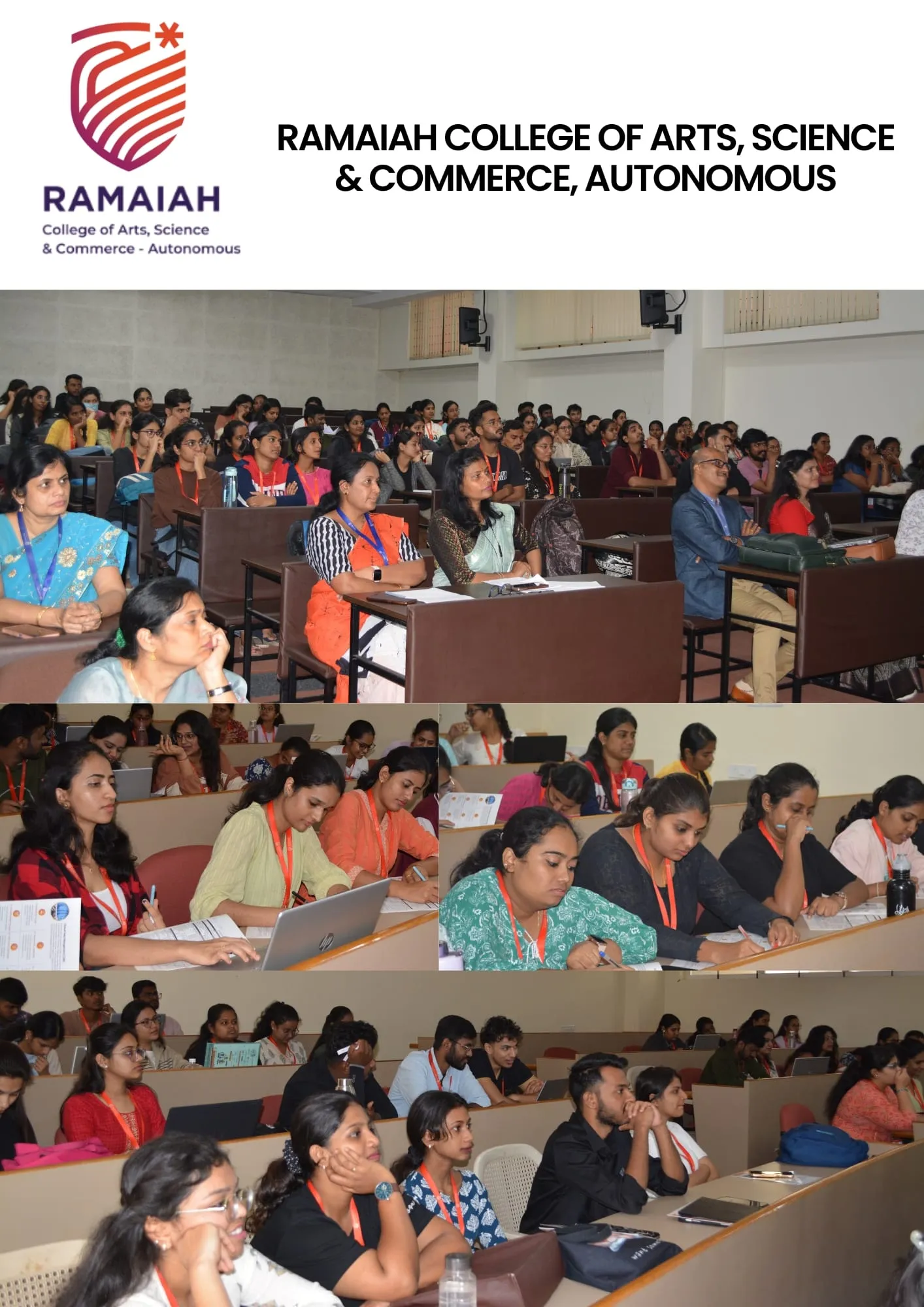
A BCRI college collaboration is a training plan we agree with your college in an MoU. It is for pharmacy, life science and health students. You choose a 1-day seminar, a 2–4 week bootcamp, a 4–8 week hybrid track or a 6–12 week add-on. Students learn clinical research, data management, drug safety or medical coding. The college gets test results and batch reports. We have MoUs with RIPER, mLAC, Ramaiah College, JAIN and REVA University.
Why colleges are adding industry programmes now
50%
of learners should get some job-skills training by 2025. That is a goal of India’s National Education Policy 2020.
Source: National Education Policy 202060–120 hrs
internship is now a must for UG students in their fourth term, under UGC’s 2023 rules.
Source: UGC guidelines (2023)3rd
largest drug industry in the world by volume. Sales were ₹4,71,898 crore in 2024-25.
Source: Dept. of Pharmaceuticals, Annual Report 2025-26490
trials were looking for patients in India on 8 October 2026. 114 of them were in Bengaluru.
Source: ClinicalTrials.gov
How we deliver
On campus, online or hybrid — built for your timetable
On campus
Our trainers come to your college. We fit your timetable.
- College-friendly time slots
- Tests and completion reports
- Optional soft-skills add-on
Online
Live classes with a trainer. Students also get recordings, quizzes and help with doubts.
- Live sessions and recordings
- Quizzes and assignments in the app
- Trainer chat for doubts
Hybrid
Workshops on campus, then online classes to finish the course.
- Workshops plus online follow-up
- Project mentoring
- Easy revision
Upskilling tracks
Training tracks for pharma and healthcare careers
Each college collaboration can use one track or several. Pick them by student year and goals.
Clinical research (CR)
- Trial phases, roles and duties
- Ethics and GCP basics
- Assignments and tests
Clinical data management (CDM)
- CRF basics and data flow
- Queries and quality checks
- Hands-on EDC demo
Pharmacovigilance (PV)
- Drug safety and the case life cycle
- Safety terms and quality basics
- Assignments and quizzes
Medical coding
- ICD, CPT and HCPCS basics
- Practice worksheets and tests
- Profile building
Soft skills & job readiness (add-on)
- Resume and interview basics
- Workplace communication
- Placement guidance
Programme models
College collaboration formats that fit your calendar
1 day
Industry orientation seminar
Best for 1st–3rd year students
- Industry overview: CR, CDM, PV, coding
- Roles and career paths
- Resume and next steps
Proposal in 2–3 working days
2–4 weeks
Bootcamp (fast track)
Best for final-year students
- Training in one track
- Assignments, quizzes and tracking
- Interview preparation
Launch plan in 5–7 working days
4–8 weeks
Hybrid track programme
Best for strong engagement
- Workshops on campus
- Online follow-ups and tests
- Project mentoring
Plan in about 7 days
6–12 weeks
Semester add-on
Best for steady upskilling
- Weekly sessions, tests and projects
- Recordings for revision
- Progress reports for the department
Schedule set in 7–10 days
Process
How it works, in four steps
- 1
Requirement call
Department, student year and count, preferred mode, timeline and goals.
- 2
Proposal and MoU plan
We agree modules, schedule, tests and the report format.
- 3
Programme delivery
Classes, assignments and projects, with student support in our learning app.
- 4
Completion and outcomes
Certificates, a completion report and plans for the next batch.
What students get
- Learning mapped to real roles in CR, CDM, PV and medical coding
- Projects, tests and completion tracking
- Internship guidance, depending on the programme and the student
- Resume and interview preparation
- App support: recordings, tests and doubt solving
- A BCRI certificate on completion
What your college gets
- MoU-backed models that fit your academic calendar
- Trainers with 10 to 20+ years of industry experience
- Batch-wise attendance and participation tracking
- Test results and progress summaries for HoDs and placement cells
- Feedback and improvement notes where needed
Internship and job support depend on eligibility, performance and openings. We do not promise jobs.
Proof from campuses
Recent college programmes and letters
Recent work includes a 36-hour Value Added Programme at Krupanidhi College of Pharmacy, plus workshops and bootcamps across Bengaluru, Vellore and Anantapur.
 Workshop · Sept 2026Clinical Research & CDM Workshop at Acharya · Hands-On Clinevo Training · BCRIAcharya Institute of Technology, Bengaluru
 Workshop · Sept 2026One-Day Clinical Research Workshop at VIT Vellore · Student Feedback · BCRIVIT, Vellore
 Value Added Programme · Jul 202636-Hour Value Added Programme (VAP) conducted by Bangalore Clinical Research Institute (BCRI)Krupanidhi College of Pharmacy, Bengaluru
 Value Added Programme · Jul 2026Student Spotlight · Rohit Kumar (VAP) conducted byBCRIKrupanidhi College of Pharmacy, Bengaluru
 Workshop · Jul 2026Meet Syeda Asfiya · Student – Krupanidhi College of PharmacyKrupanidhi College of Pharmacy, Bengaluru
 Workshop · Jul 2026A Testament to Industry-Academia Excellence!Dr. Raman Dang, Principal, Krupanidhi College of PharmacyKrupanidhi College of Pharmacy, Bengaluru
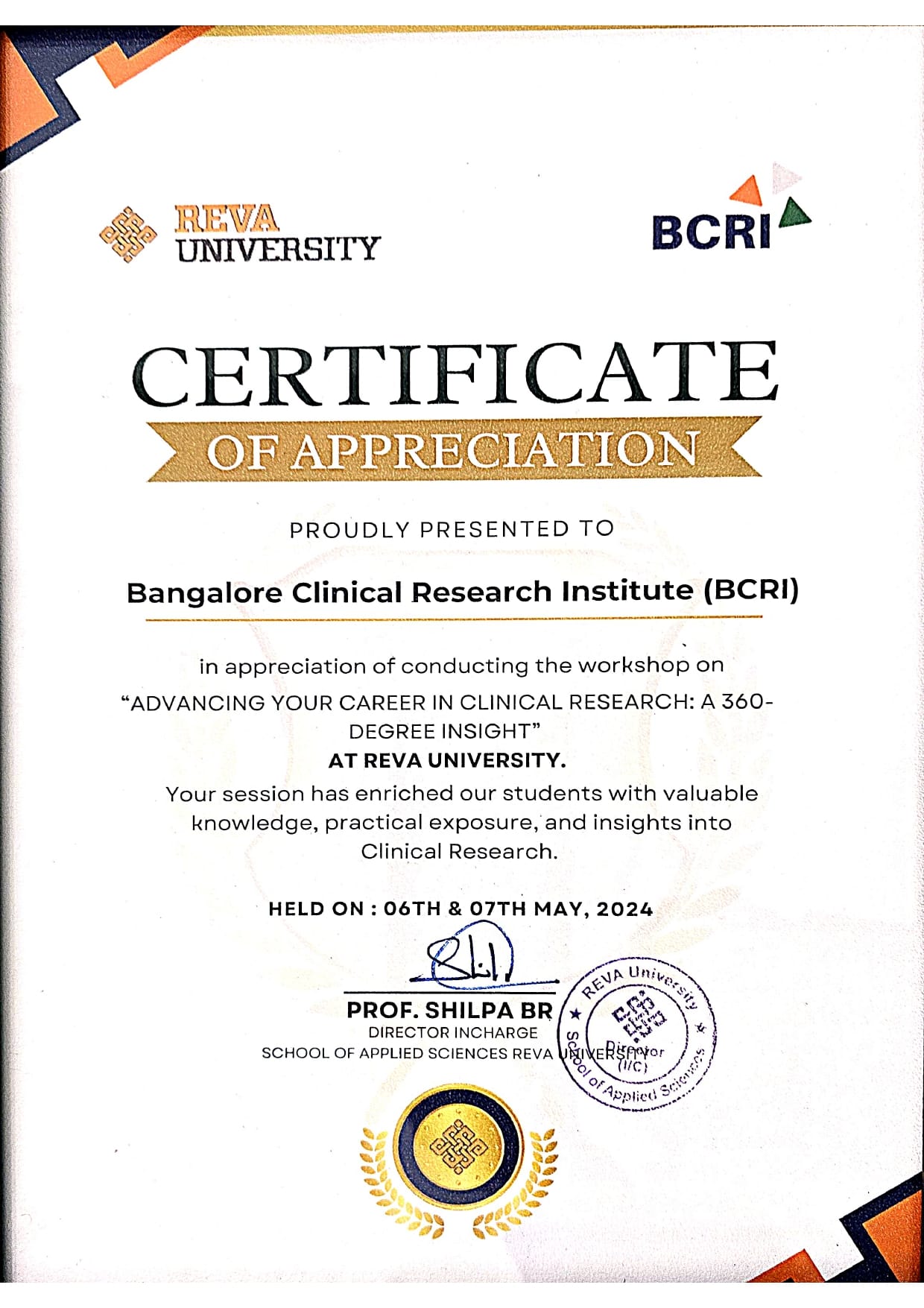
 REVA University, School of Applied SciencesLetter of appreciation · 6–7 May 2024
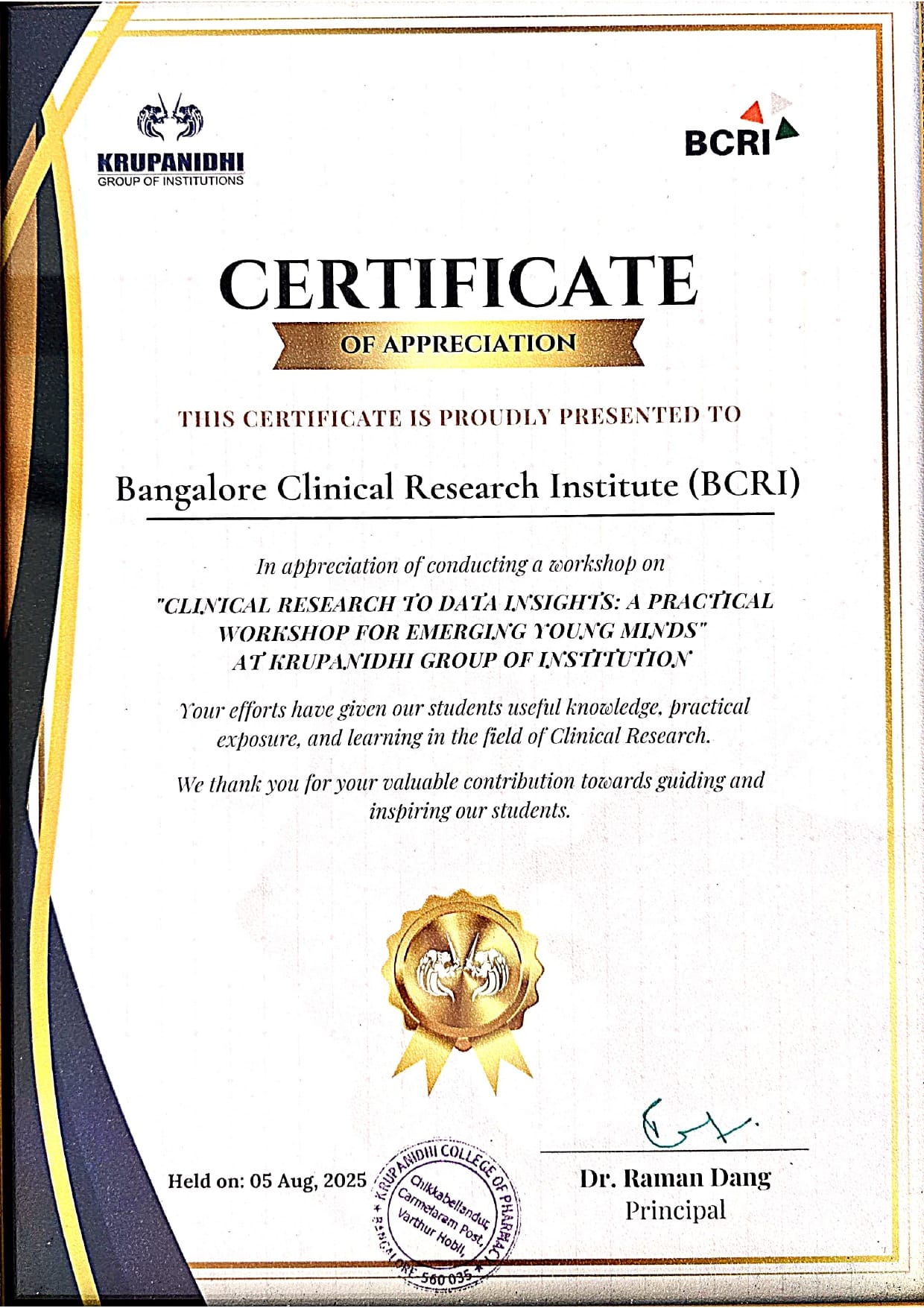
 Krupanidhi College of Pharmacy (Krupanidhi Group of Institutions)Letter of appreciation · 5 August 2025
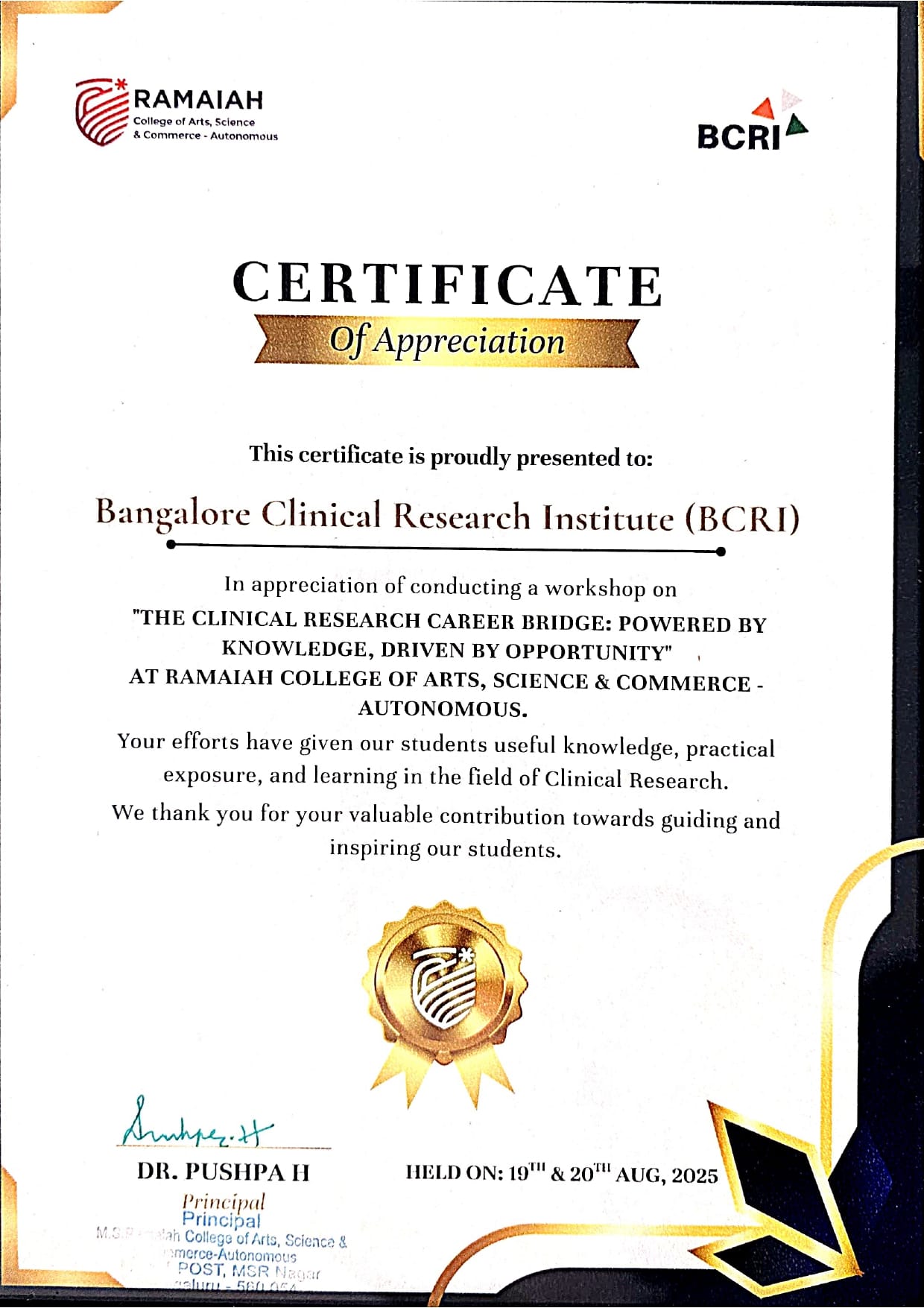
 Ramaiah College of Arts, Science & Commerce (Autonomous)Letter of appreciation · 19–20 August 2025
All events on the BCRI Career Hub → · Workshops for colleges →
FAQs
College collaboration FAQs
What is an industry–academia tie-up with BCRI?
It is an MoU-based programme where BCRI trains your students in clinical research, clinical data management, pharmacovigilance or medical coding, on campus, online or hybrid, around your timetable.
Which colleges have MoUs with BCRI?
RIPER (Anantapur), Maharani Lakshmi Ammanni College for Women (mLAC), Ramaiah College of Arts, Science & Commerce, JAIN (Deemed-to-be University) and REVA University. See our collaborations page for the MoU proof.
What formats can a college choose?
A 1-day industry orientation seminar, a 2–4 week bootcamp, a 4–8 week hybrid track or a 6–12 week semester add-on.
Which students is it for?
Pharmacy (B.Pharm, M.Pharm, Pharm.D), life science, biotechnology, nursing and allied health students. Seminars suit 1st–3rd years; bootcamps suit final-year students.
Can the programme count towards UGC internship hours or academic credit?
That is the college’s decision. UGC’s 2023 guidelines ask for a 60–120 hour internship in the fourth semester. Tell us your plan and we will share the hours, topics and reports you need to decide.
Do students get certificates?
Yes. Students receive a BCRI certificate on completion. Some longer programmes can also lead to an LSSSDC certificate after LSSSDC’s offline exam.
What reports does the college receive?
Batch-wise attendance, participation, test completion and a progress summary, plus feedback where needed.
Do you promise internships or jobs?
No. We give internship guidance and job-readiness support. Actual places depend on eligibility, performance and openings.
How soon can a programme start?
A seminar proposal usually takes 2–3 working days. Bootcamps take about a week to plan, and semester add-ons 7–10 days. Final dates depend on your schedule and approvals.