
Certificate Program · Drug Safety
✓ Dual certification: BCRI + LSSSDCPharmacovigilance training in Bangalore & Online
A 2-month drug safety course with hands-on safety database training, ICSR case processing, MedDRA coding and narrative writing. Join live online, or in our classroom at HSR Layout, Bangalore.
- Duration
- 2 months
- Mode
- Online + Classroom
- Next batch
- 15 Oct 2026
- Certificate
- BCRI + LSSSDC
Course fee₹22,500
4.6/5 · 987 Google reviews


- LSSSDC · NSDC · Skill India training partner
At a glance
What is pharmacovigilance — and why train with BCRI?
BCRI’s pharmacovigilance training is a 2-month certificate course in drug safety. You learn how adverse events are reported, checked, coded and sent to regulators, and you practise on a real safety database. It also covers the basics of regulatory affairs. It suits pharmacy, life science and medical graduates who want to become Drug Safety Associates.
Pharmacovigilance (PV) is the work of finding, checking and preventing the side effects of medicines. The World Health Organization defines it this way. Its goal is to keep patients safe when they use medicines, vaccines and medical devices.
Drug safety monitoring is a legal requirement in most countries, so pharma companies, CROs and biotech firms always need trained PV staff. At BCRI, our pharmacovigilance training prepares you for real drug safety jobs. We use an up-to-date syllabus, expert-led classes and practical case work.
You learn the theory and how to use it at work. You study ICH, WHO, CDSCO, US FDA and EU EMA rules. You process cases on a safety database and write safety narratives.
Last updated
Why BCRI
Why choose BCRI for your pharmacovigilance training?
Safety database practice
Hands-on training on a safety database, such as Clinevo, for real case processing.
Live interactive sessions
Real-time classes and Q&A with trainers from the drug safety industry.
Recorded classes
3-month access to recorded sessions on the BCRI class app.
Real case studies
Work through real-world case scenarios, role plays and discussions.
PV + regulatory basics
Pharmacovigilance and the basics of regulatory affairs in one course.
Placement assistance
Resume building, mock interviews and job referrals from the placement team.
Skills you will gain
- End-to-end ICSR case processing: seriousness, causality and expectedness
- Hands-on work on a safety database such as Clinevo
- Adverse event reporting to US FDA, EMA and CDSCO
- Coding events and drugs with MedDRA and WHO drug dictionaries
- Writing compliant safety case narratives
- ICH, WHO and country-specific drug safety guidelines
- Signal detection and risk management basics
Curriculum
Pharmacovigilance training syllabus
Eleven modules, from drug development basics to case processing, signal detection and aggregate reports.
- Modules
- 11
- Topics
- 46
- Duration
- 2 months
Want the detailed syllabus?
An advisor will share the full module plan on WhatsApp or email.
Get the syllabus1
Drug Discovery and Development
5 topics- Discovery and development
- Preclinical research
- Clinical research
- Drug review and post-market
- Drug safety monitoring
2
Introduction to Pharmacovigilance
6 topics- WHO definition and history of pharmacovigilance
- Scope and purpose of PV
- Basic terms and definitions
- Types of adverse event (AE) reporting
- Types and sources of data
- The PV process: signal detection and drug recall
3
Regulatory Aspects of Pharmacovigilance
4 topics- WHO–UMC (Uppsala Monitoring Centre)
- CIOMS and ICH-GCP
- The European pharmacovigilance system
- Different regulatory authorities
4
Reporting to Health Authorities and Timelines
3 topics- Reporting formats used in PV
- PSUR and DSUR overview
- PBRER and PADER
5
Safety Database Workflow
10 topics- Case receipt, data verification and validity check
- Triage and data entry
- Coding of AEs and drugs
- Causality and expectedness assessment
- Case narrative and quality check
- Reporting, submission, deletion and nullification
- Initial receipt date and the importance of day 0
- Case linking; mother and baby cases
- Special cases: lack of efficacy, off-label use, misuse, overdose, pregnancy and medication error
- Practice on real-time case scenarios
6
Drug and ADR Dictionaries, Event Coding
5 topics- WHO Drug Dictionary
- COSTART
- MedDRA
- ADR classification
- SAEs and seriousness criteria
7
Case Processing
4 topics- AE reporting
- Case intake and triage
- Causality assessment
- WHO–UMC causality assessment system
8
Signal Detection
1 topics- Finding and assessing safety signals
9
Case Studies
1 topics- Real-world pharmacovigilance case studies
10
Narrative Writing
3 topics- Overview and features of a case narrative
- Sections of a case narrative
- Steps to build a narrative
11
Aggregate Reporting
4 topics- Overview of aggregate reporting
- Types of reports
- Data analysis and interpretation
- Risk Management Plan (RMP)
Fees & batches
Pharmacovigilance Training fees and upcoming batches
Course fee
₹22,500
2 months · Live online or classroom (HSR Layout, Bangalore)
What’s included
- Live interactive classes — online or classroom
- Safety database live training
- Real-world case studies and ICH/WHO guidelines
- Class recordings on the BCRI app (online batches)
- Resume building, interview preparation and placement assistance
- BCRI certificate + eligibility for the LSSSDC (NSQF-aligned) assessment
Paying the full fee online? Use code GET5 at checkout for 5% off. Instalment options are available — ask an advisor. New batches start every month.
Compare all course fees →Upcoming batches
- Reserve a seat
Live online batch
Starts 15 Oct 2026
Ends 18 Dec 2026 · Mon-Fri . 7pm-8pm · BCRI, HSR Layout, Bengaluru
- Monday–Friday classes
- Recordings for online batches
- Online or HSR Layout, Bengaluru
- Instalment options available
Certification
Pharmacovigilance certification
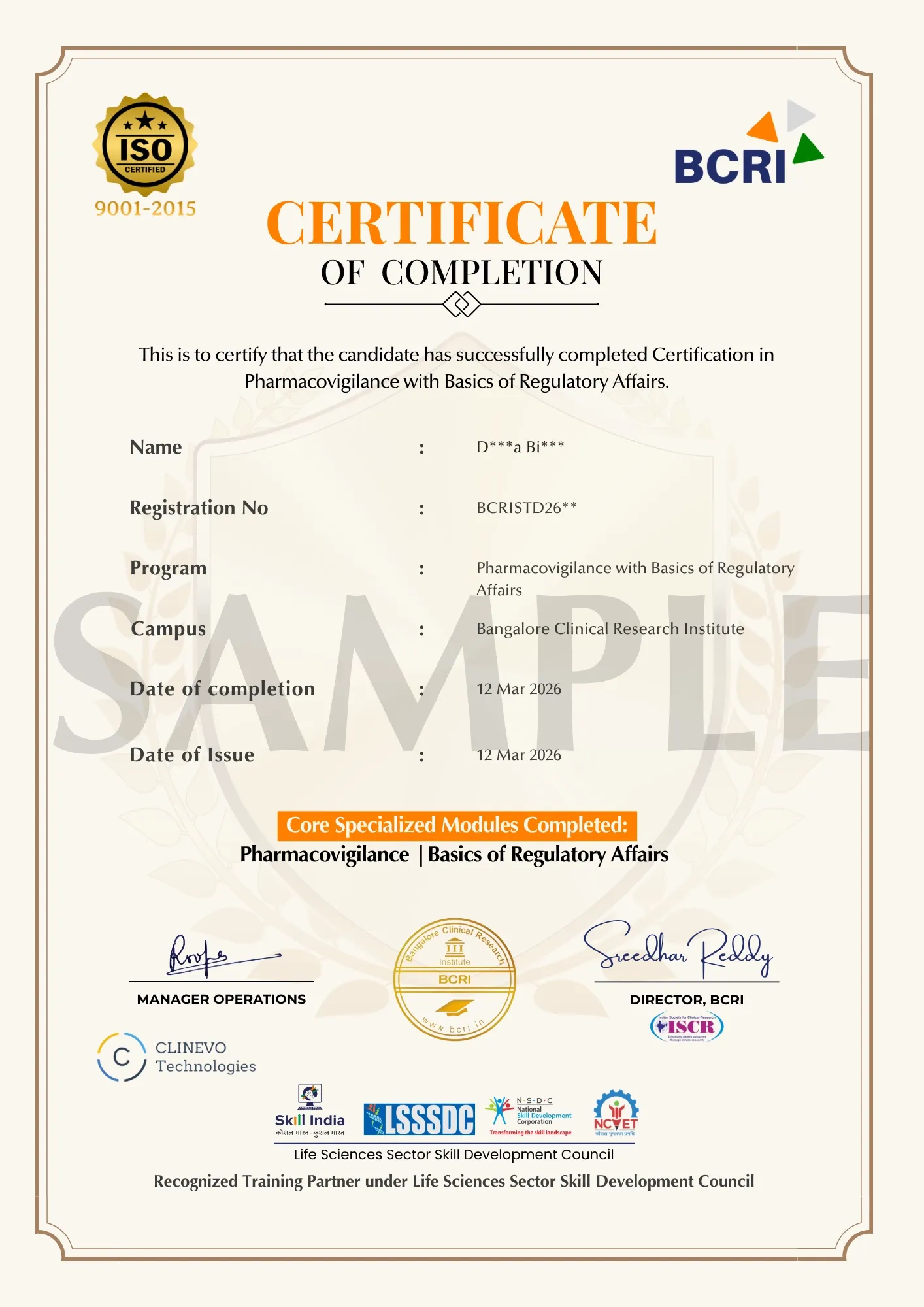
On completion you receive the BCRI Certificate of Completion in Pharmacovigilance with Basics of Regulatory Affairs, listing your core modules. It carries the Skill India, LSSSDC, NSDC and NCVET marks, as BCRI is a recognised training partner under the Life Sciences Sector Skill Development Council.
This course is part of BCRI’s Dual Certification: pass LSSSDC’s offline exam to earn a second, NSQF-aligned certificate from LSSSDC.
What your certificate shows
- Certificate of CompletionIssued by Bangalore Clinical Research Institute
- Core modules completedPharmacovigilance · Basics of Regulatory Affairs
- Registration numberUnique to you and verifiable online
Recognition marksISO 9001:2015 · Skill India · LSSSDC · NSDC · NCVET · Clinevo
Dual Certification Advantage
Dual certification: BCRI + LSSSDC
With BCRI’s Dual Certification, you earn two certificates from one programme. The first is your BCRI course certificate. The second is a national skill certificate from the Life Sciences Sector Skill Development Council (LSSSDC), which you get after you pass its offline exam. The LSSSDC certificate follows India’s National Skills Qualifications Framework (NSQF).

Certificate 1 · BCRI
BCRI Course Certificate
- When:
- Awarded when you complete the course and BCRI’s internal assessments.
- What it shows:
- Shows the programme and core modules you completed, issued by an ISO 9001:2015 certified institute.

Certificate 2 · LSSSDC
LSSSDC Skill Certificate (NSQF-aligned)
- When:
- Awarded after you clear LSSSDC’s offline assessment, conducted independently by LSSSDC or its authorised assessment agency.
- What it shows:
- Certifies your skills against a national Qualification Pack for the life sciences sector, under the Skill India / NSDC ecosystem.
Step 1
Train
Complete your BCRI programme — live online or at HSR Layout.
Step 2
BCRI assessment
Clear BCRI’s internal assessments and receive your BCRI certificate.
Step 3
LSSSDC assessment
Take LSSSDC’s offline assessment, conducted independently by LSSSDC or its authorised agency.
Step 4
LSSSDC certificate
Pass the exam and receive your NSQF-aligned LSSSDC skill certificate.
You get the LSSSDC certificate only after you pass LSSSDC’s offline assessment.
Careers & salary
Career opportunities after pharmacovigilance training
With more focus on patient safety around the world, pharma companies, CROs, hospitals and regulators need trained drug safety staff. Most freshers start as Drug Safety Associates or PV Associates. Safety database, coding and case processing skills help you stand out.
Job roles you can apply for
- Drug Safety Associate
- Pharmacovigilance Associate
- Safety Data Analyst
- Case Processing Specialist
- Medical Data Reviewer
- Regulatory Affairs Executive
- Medical Coding Specialist
- PV Operations Coordinator
Where you can work
- Pharmaceutical companies
- Contract research organisations (CROs)
- Hospitals
- Regulatory agencies and biotech firms
Hiring locations
- Bengaluru
- Hyderabad
- Chennai
- Mumbai
- Pune
- Remote global safety teams
Typical career progression
- 1
Entry
Drug Safety Associate · PV Associate
- 2
2–4 years
Senior DSA · Case Quality Reviewer
- 3
4–7 years
Drug Safety Specialist · PV Scientist
- 4
Leadership
PV Team Lead · Clinical Safety Manager
Salary range — market data
| Role | Experience | Typical salary | Source |
|---|---|---|---|
| Drug Safety Associate · Bengaluru | 0–4 years | ₹3.8 – 4.2 lakh per year | AmbitionBox, 747 salaries, updated 7 Oct 2026 |
| Pharmacovigilance Associate · Bengaluru | 0–5 years | ₹3.8 – 4.2 lakh per year | AmbitionBox, 230 salaries, updated 25 Sep 2026 |
| Drug Safety Specialist · Bengaluru | 1–7 years | ₹6 – 7.1 lakh per year | AmbitionBox, 57 salaries, updated 5 Sep 2026 |
Figures are third-party market data for these roles, not BCRI placement outcomes. Actual pay depends on the employer, skills, certification and interview performance.
Student proof
Pharmacovigilance training reviews, placements and student stories
4.6
BCRI is rated 4.6/5 from 987 Google reviews (as of Oct 2026)
It has been 2 months of a great journey with the BCRI team, especially our tutor Mayuri ma’am, who has years of experience in PV. The classes were very interactive, with case-solving sessions, role plays and discussions, and they also provide recorded sessions so we could go back and check again.
Fousiya AnsarAli — Pharmacovigilance The pharmacovigilance certification course has been exceptional. Dev Sir’s expertise and teaching style simplified complex topics. The course materials were well-structured. I highly recommend this course to anyone interested in pharmacovigilance.
Versha Giroh — Pharmacovigilance certification I have completed my Pharmacovigilance course from BCRI. I appreciate Dev Sir’s teaching method, patience and dedication, which enhanced our understanding of the topic.
Anupa K A — Pharmacovigilance
Recent BCRI placements & internships




Watch

Understanding adverse drug reactions: a complete guide
Advanced drug safety and pharmacovigilance career — webinar

Dilip Gowda
Read story of Dilip Gowda →
Is this course right for you?
Talk to a BCRI advisor about eligibility, batches, fees and career paths. It’s free and there’s no obligation.
FAQs
Pharmacovigilance Training — frequently asked questions
What is pharmacovigilance?
Pharmacovigilance (PV) is the science of finding, checking, understanding and preventing the side effects of medicines, as defined by the World Health Organization. Its main goal is to keep patients safe when they use medicines, vaccines and medical devices.
How long is the pharmacovigilance training and what does it cost?
The course runs for 2 months, online or at HSR Layout, Bangalore, with new batches every month. The fee is ₹22,500. Paying the full fee online with code GET5 gives 5% off, and instalments are available.
Who is eligible for pharmacovigilance training?
Life science, pharmacy and medical graduates and postgraduates can join, including BDS, BAMS, BHMS and BPT. You do not need any industry experience.
Do I get an LSSSDC certificate with this course?
Yes. This course is part of BCRI’s Dual Certification. You get the BCRI certificate in Pharmacovigilance with Basics of Regulatory Affairs, and an NSQF-aligned LSSSDC certificate when you pass LSSSDC’s offline exam.
Is pharmacovigilance a good career?
Yes. Drug safety monitoring is a legal requirement, so pharma companies, CROs and regulators always need PV staff. India is one of the largest drug producers in the world, which creates many PV jobs. AmbitionBox reports Drug Safety Associates in Bengaluru earning about ₹3.8–4.2 lakh a year (Oct 2026).
What jobs can I get after pharmacovigilance training?
Freshers usually start as Drug Safety Associates, PV Associates or case processors. With experience you can become a drug safety specialist, PV scientist, team lead or clinical safety manager.
Where can pharmacovigilance professionals work?
You can work in pharma companies, CROs, hospitals and drug regulators. Common job titles are drug safety associate, PV officer, PV scientist, PV manager and PV consultant.
Is there scope for pharmacovigilance abroad?
Yes. Patient safety rules apply worldwide, so PV skills are needed in the US, Europe, Australia and other markets. BCRI’s training follows ICH, WHO, US FDA and EU EMA guidelines.
Is an internship included with the pharmacovigilance course?
Internships of 3 to 6 months are included in BCRI’s diploma and Advanced Certification programmes. If you want an internship with drug safety training, choose the Advanced Diploma or a PG Diploma in Clinical Research — an advisor can help you decide.
Does BCRI provide placement support?
Yes. Our placement team helps every student with resumes, interview practice and job referrals to CROs and pharma companies. The employer makes the final hiring decision based on your interview, so a job is not guaranteed.